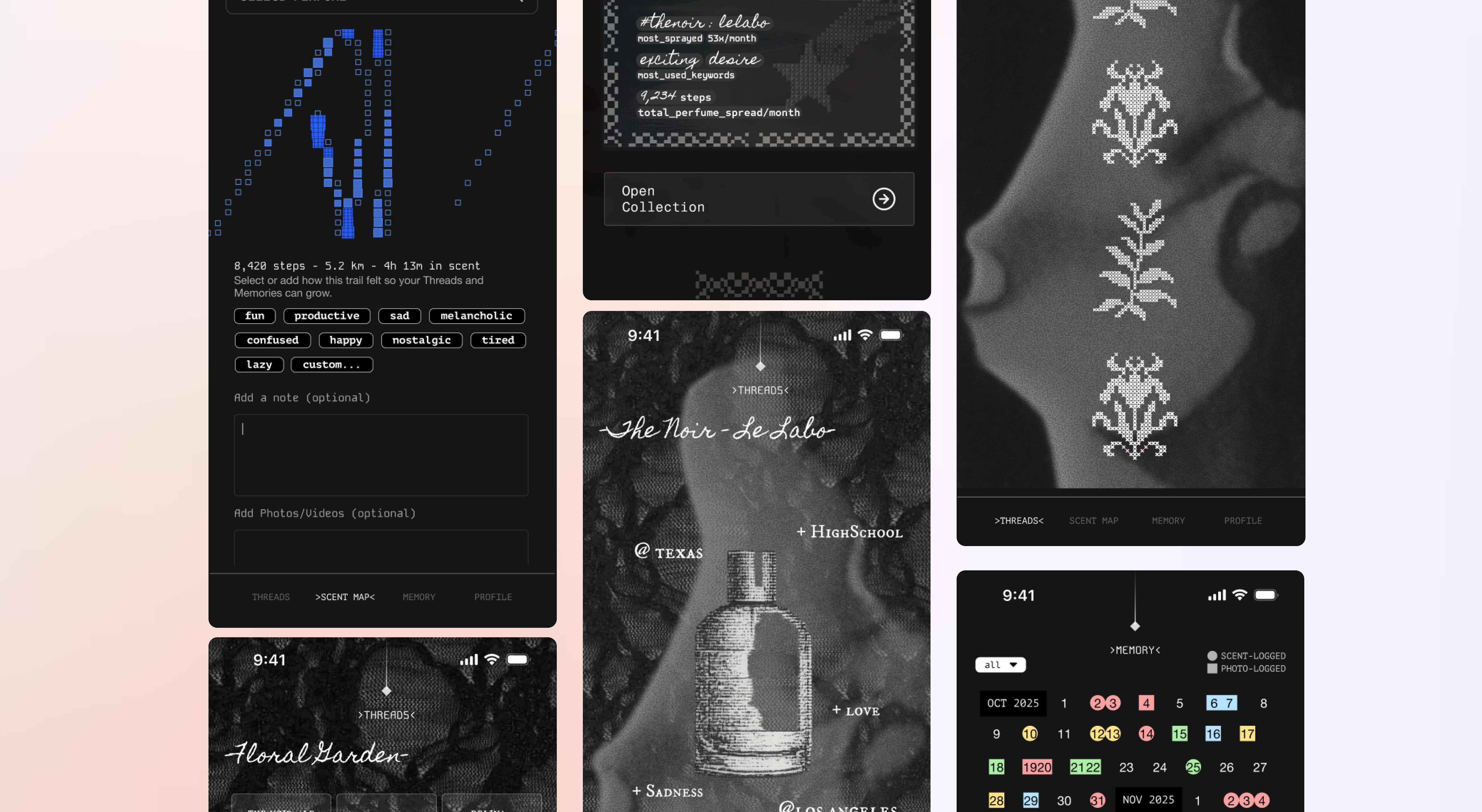
A scent-tracking experience that connects perfume to the places, patterns, and moments that give it meaning.
For me, perfume has always carried traces of where I've been. A scent can become attached to a particular era, place, or person, but those connections rarely make it into the way we record what we wear. Most perfume tracking tools capture the product and the date, leaving the rest of the story behind.
Plume is my attempt to give those associations a technical body — a way to record not just what I wore, but where I walked in it, how often, and how it felt. It's not a hyper-optimized daily tool. It's a carefully crafted space for people who care deeply about scent, memory, and aesthetics.
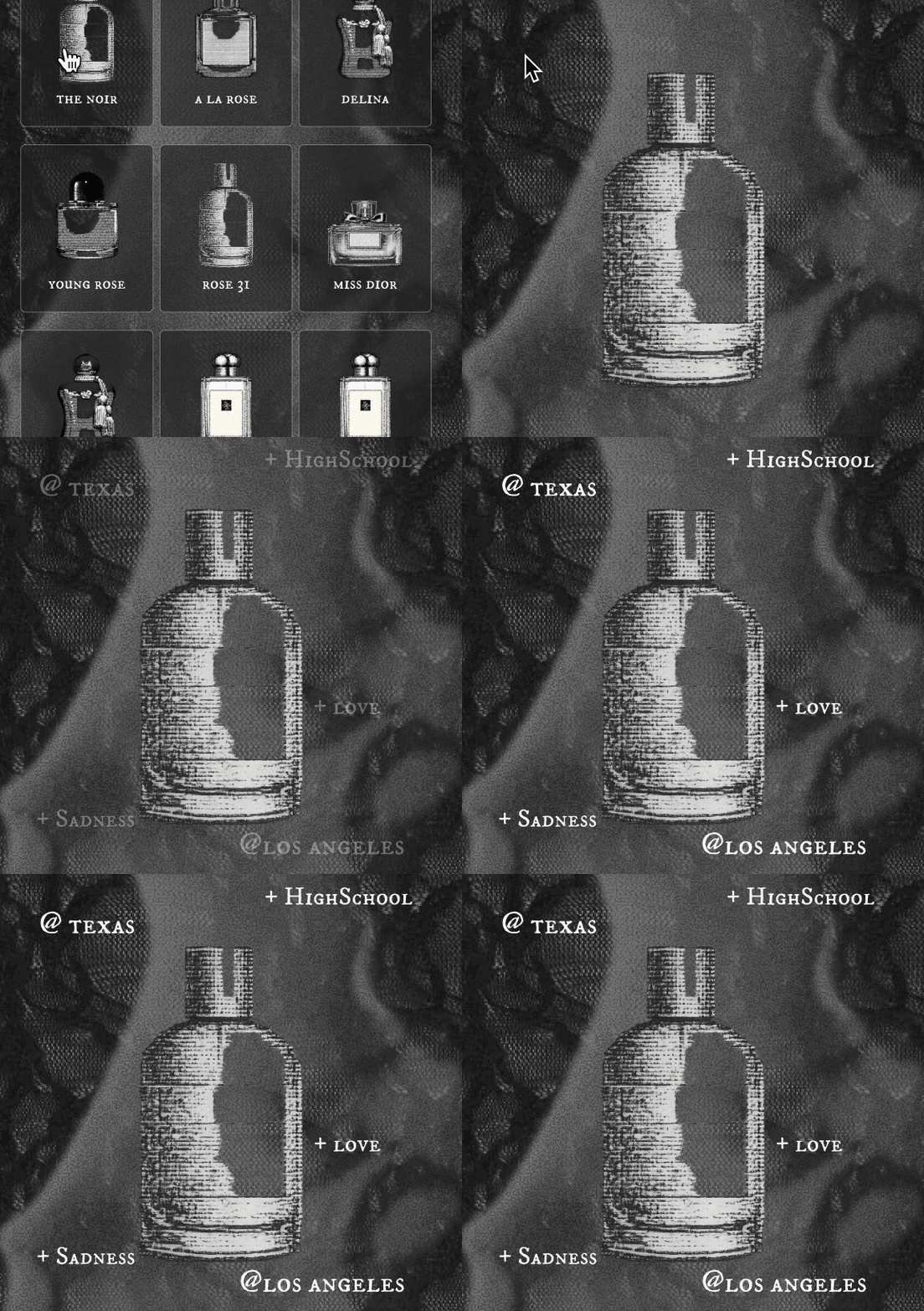
Most fragrance apps are built around the bottle: what you own, when you wore it, and how you rated it. But the memories that make a scent meaningful often live outside the bottle — in the places you wore it, the people you were with, and the patterns that emerge over time.
Fragrance tracking usually begins with the bottle — what you own, when you wore it, and how you rated it.
A scent can become tied to a place, a routine, or a particular moment, but that context rarely becomes part of the fragrance record.
Over time, repeated wears can reveal patterns across scents, places, and memories but those relationships aren't visible in a traditional log.
AI extracts keywords, emotions, and context from diary entries, connecting what you write to the scents you wear.
%201.gif)
Turn individual scent entries into relationships — showing recurring fragrances, places, and behaviors that aren't obvious from a traditional log.
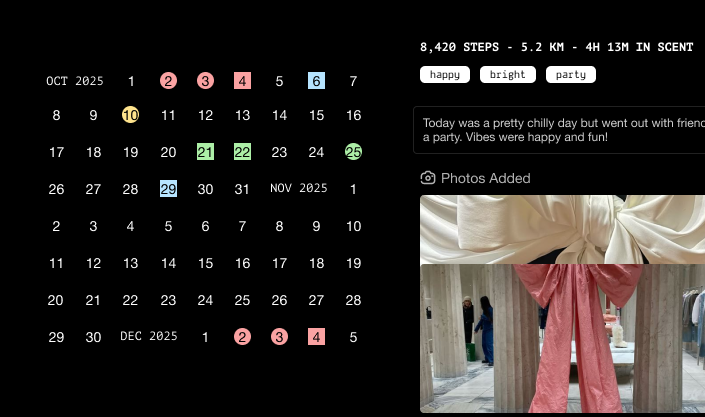
A calendar brings scents and their associated memories back into view, letting you see what you wore and what was happening around it.
Plume reimagines fragrance tracking as something more than a log of bottles and dates. It connects what you wear to patterns, places, and memories, giving each scent multiple ways to be understood over time.
Threads turns individual fragrance entries into patterns. Instead of looking at each wear on its own, you can see which scents return, how often you reach for them, and how your relationship with your collection changes over time.
Scent Map connects fragrance to place, turning individual wears into a visual trail. Rather than treating location as an address, Plume uses density, movement, and proximity to show where a scent has accumulated in your life.
Memory connects perfume to the moments surrounding it. Diary entries, dates, and personal context turn a fragrance from something you logged into something you can return to.
Perfume doesn't have a natural digital form. I explored familiar visual systems — maps, trails, and physical craft — to find ways of representing scent that felt personal rather than purely functional.
.gif)
When I first thought about “scent trails,” my instinct was to lean on what already exists: a map with streets, pins, and routes. But the more I explored it, I realized I didn’t want Plume to help you navigate the world; I wanted it to help you remember how it felt to move through it with a specific perfume.
So instead of a literal city map, I designed Plume Map as an abstract bitmap using p5.js. Each day’s steps become tiny marks on a grid, and over time those marks build into dense “scent zones” rather than precise paths.
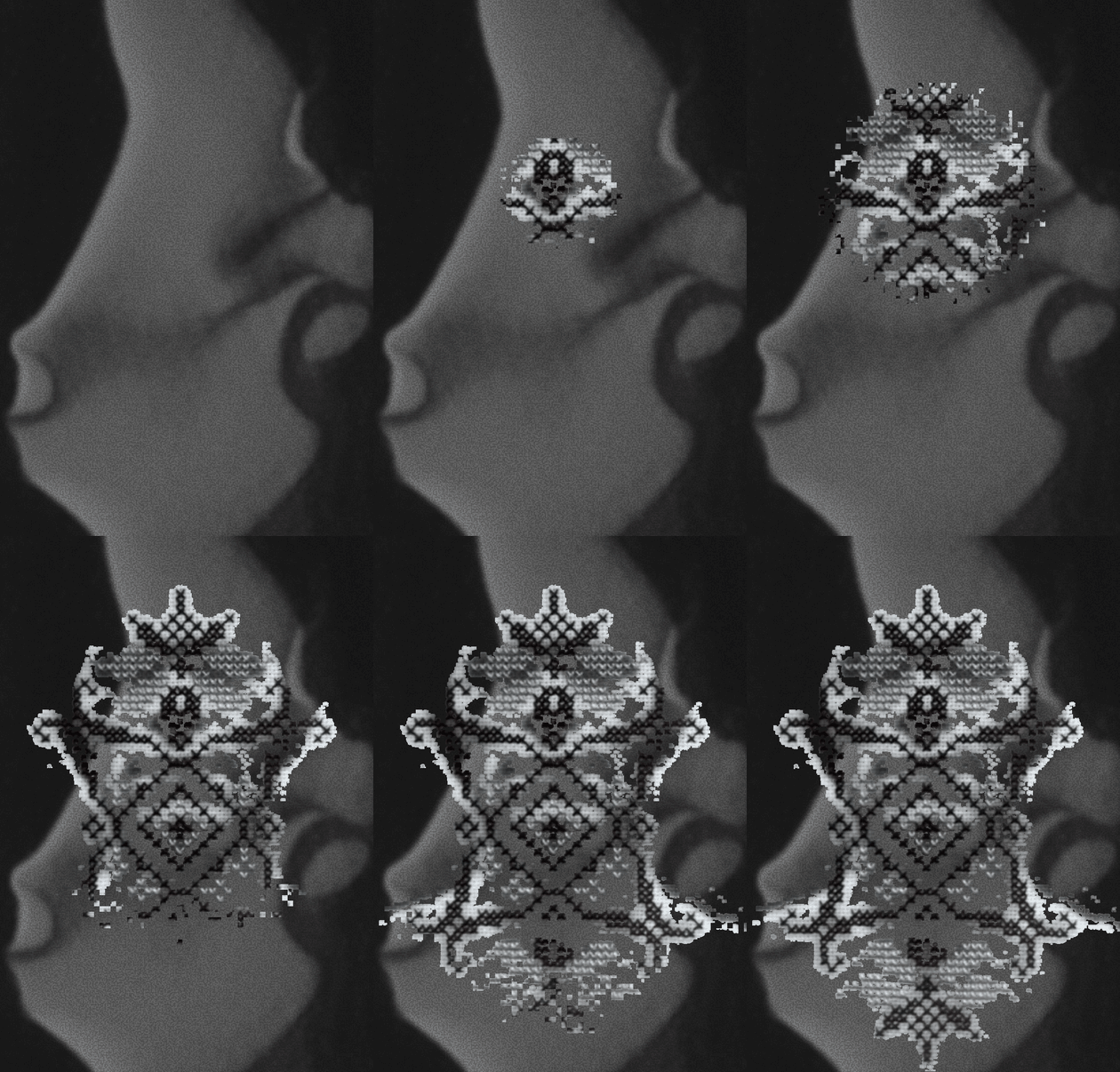
I was drawn to the history of embroidered self-portraiture — the idea that a person could represent themselves through something they made by hand. The thread wasn't just the medium; it became part of the identity being represented.
That idea became the starting point for Plume's visual language. If perfume can accumulate memories, places, and moments over time, I wanted those experiences to leave a similar kind of trace. Embroidery became the motif for those traces — each scent, wear, and memory adding another thread to the portrait.
Plume already collects signals from scent, notes, and movement. The challenge was figuring out where AI could make those signals more meaningful — without turning the experience into a chatbot or letting the system decide what something means.
I wanted AI to work quietly in the background: finding patterns, suggesting interpretations, and giving users something to react to. The final meaning always stays with the person.
A memory can contain much more than a single feeling. Plume uses AI to identify keywords, emotions, and contextual signals from a user's note, then turns them into editable tags.
Location data tells Plume where you've been, but raw coordinates don't say much about why a place matters. AI looks for recurring movement patterns and combines them with personal context to suggest meaningful clusters.
.gif)
Plume started as a personal question: what if the way I experience perfume could become something I could actually see? Because I was designing for myself, I had more freedom to follow ideas that wouldn't necessarily make sense in a conventional product — from abstract maps and embroidery to tarot-inspired interpretations.
But that freedom also made the project harder. Without a predefined product category or business goal to optimize for, I had to constantly ask myself: Is this helping me understand my relationship with scent, or am I just making something visually interesting?
Plume taught me that data doesn't have to make an experience feel clinical. The same information — a location, a date, a repeated wear — can become something emotional when it's connected to the context around it.
Some of the most important decisions came from explorations that weren't obviously “product design” — p5.js experiments, embroidery, and tarot. They helped me discover visual and interaction systems that I wouldn't have arrived at by starting with a conventional UI.
Designing for myself gave me the freedom to follow my own curiosity, but it also forced me to justify every decision. A visual can be personal and expressive while still needing a clear reason to exist.
A little look into how I think, make, and design. Thanks for being here.