A personal experiment in perfume, identity, AI, and data visualization.
ROLE
Designer
DURATION
Present
TOOLS
Figma, Illustrator, Photoshop, p5.js, TouchDesigner, Premiere Pro, Claude Code
ROLE
Designer
DURATION
Present
TOOLS
Figma, Illustrator, Photoshop, p5.js, TouchDesigner, Premiere Pro, Claude Code
INTENT + CONTEXT
Perfume is one of the most personal things about a person — certain scents are tied to specific eras, places, and people. But scent leaves almost no visible trace. Most tracking tools flatten that experience into a simple list of dates, products, and notes.
Plume is my attempt to give perfume a technical body — a way to record not just what I wore, but where I walked in it, how often, and how it felt. It's not a hyper-optimized daily tool. It's a carefully crafted space for people who care deeply about scent, memory, and aesthetics.
SYSTEM
EXPERIENCE ARCHITECTURE
The challenge was to keep these three views visually distinct but clearly related—same scents, same trails, same memories—just rendered through different lenses.
.gif)
Perfumes accumulate over time to form stitched patterns, creating an evolving portrait of a user's scent identity. Each scent family becomes its own stitch pattern—color, density, and opacity shift as wear frequency accumulates.

Movement data and timestamps generate abstract scent trails on a bitmap grid, showing where and how often specific perfumes appear in daily life. Clusters reveal recurring locations and routines.
.gif)
Daily perfume logs capture emotions, notes, and photos in a calendar view. Instead of reminders and meetings, it highlights the days you logged a scent — a diary, not a scheduler.
DESIGN DECISIONS
.gif)


Identity = perfume = data

While ideating on ways to represent identity through perfume—beyond a literal headshot—we chose embroidery as our primary language. Historically, stitching lived close to the body and signaled who you were; in Plume, each perfume family becomes its own stitch pattern, and each scent shifts the color, density, or opacity of that pattern. Over time, the embroidered face turns into a kind of scent signature: data about wear frequency, eras, and families is encoded into something that looks like textile, not a chart.

Threads becomes your personal embroidery cloth—a surface that always stays recognizably you, but never distracts from the stitches. As you log different perfumes over time, new stitch patterns are layered onto this cloth, slowly turning your face into a living record of your scent identity.

Instead of asking for a legal name, Plume asks you to sign when you first onboard. That mark—whether it’s a doodle, a nickname, or a real signature—becomes the way the app addresses you. The goal is to make Plume feel like a personal space you authored yourself, not an account you registered for.
AI FEATURES
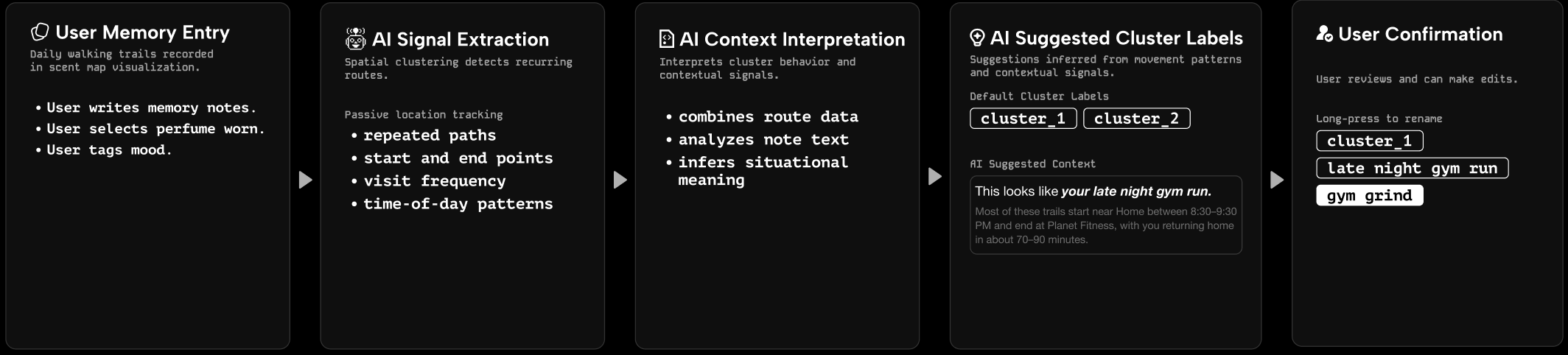
AI in Plume focuses on pattern discovery, not decision-making. The system extracts signals from scent logs, notes, and movement trails to suggest tags, cluster locations, and generate symbolic imagery. Users remain in control by confirming, editing, or rejecting these interpretations, ensuring reflection stays personal.
I knew I wanted to incorporate AI, but didn’t want AI to show up as a chat box or a personality. Plume already has enough quiet data (steps, dates, notes, photos, and GPS) — the question I was asking myself was: where can AI make data more readable without rewriting my story for me?
Natural language signals extracted from memory notes generate contextual tags that users can confirm, edit, or remove.
%201.gif)

Route patterns inferred from background location data are translated into meaningful cluster labels that users can confirm, edit, or remove.
.gif)
REFLECTION
This is probably the first time in a while that I’ve designed an app purely for myself. It felt really different from typical product work—freeing, but also a little scary—because there wasn’t a clear business metric or stakeholder to answer to, just my own taste and curiosity. Plume became a space where I could pull in all the tools and techniques I’ve learned at school—embroidery, bitmap experiments, motion, data-viz—and ask, “Is this actually necessary? Does this still read?” I had to keep switching between designer-brain "does this pattern communicate?" and user-brain "would I actually enjoy using this every day?"
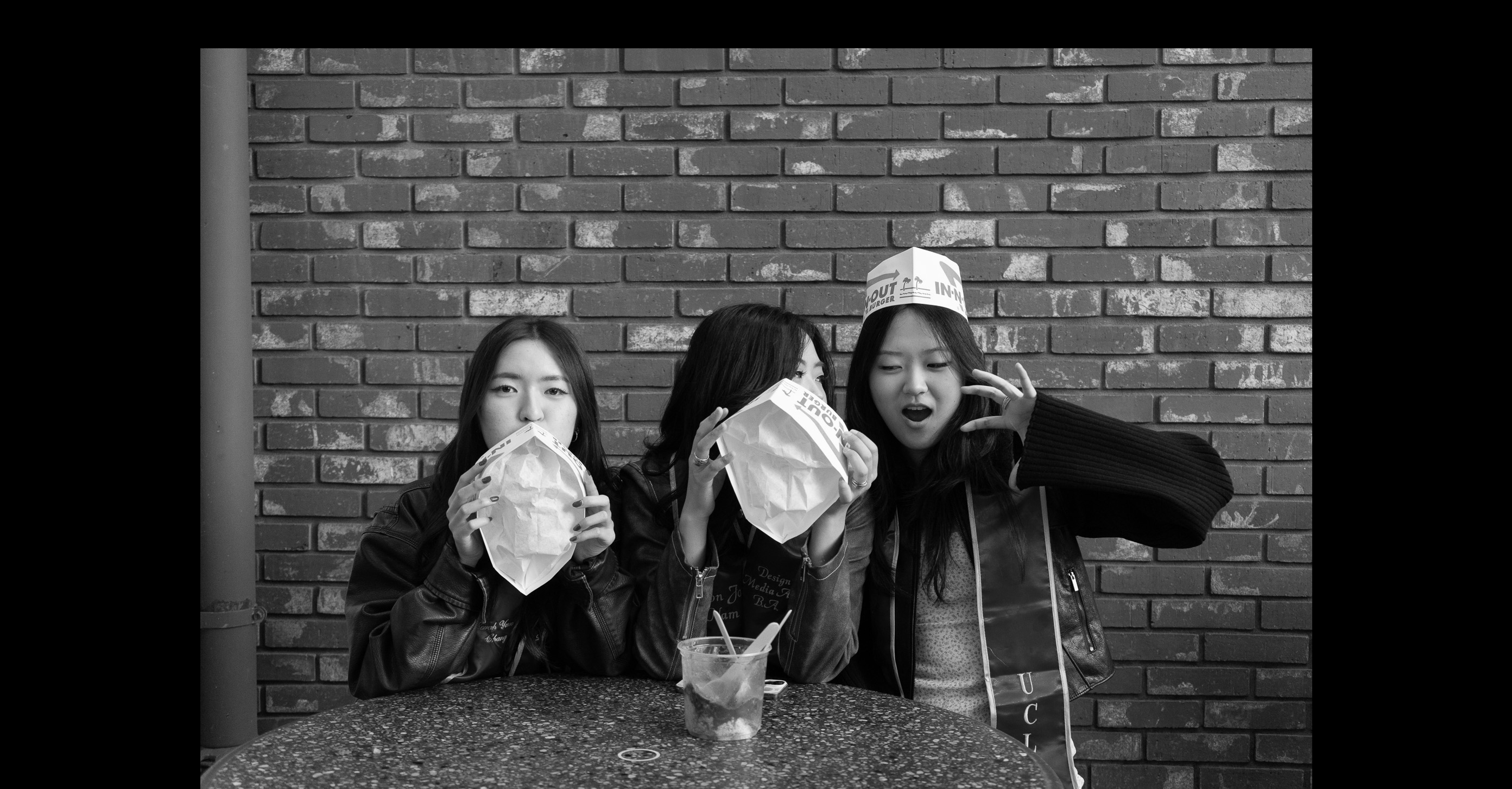
The most meaningful part was building it with my close friends who are just as obsessed with perfume. We weren’t just “designing a feature list”; we were translating our own habits, jokes, and rituals into an interface. In the end, Plume feels less like a polished product and more like a shared artifact—a reminder that designing for yourself and the people close to you can be just as valuable as designing for millions.

Learn more about my love for perfume, here :p